

It sounds alarming: PFAS in the blood of almost everyone. But what does that actually mean? How do you get them? And more importantly: what can you do about it yourself? We dive into the science and give you practical guidance.
What are PFAS and why are they everywhere?
PFAS (per- and polyfluoroalkyl substances) are a group of more than 10,000 chemical compounds that have been used in all kinds of products since the 1940s. They make materials water-repellent, grease-repellent, and heat-resistant. Handy — and that’s exactly why they’ve ended up in:
- Non-stick coatings in pans (Teflon/PTFE)
- Water-repellent clothing (Gore-Tex, rain jacket)
- Pizza boxes and microwave popcorn packaging
- Cosmetics (mascara, foundation)
- Fire extinguishers
- Carpets and upholstery fabric
The problem: PFAS hardly break down. Not in the environment, and not in your body. They build up — in your blood, your liver, your breast milk. Hence the name “forever chemicals.”
What does the research say?
In 2020, the European Food Safety Authority (EFSA) concluded that current PFAS exposure in large parts of the European population exceeds the limit values. Specifically, for four common PFAS variants (PFOA, PFNA, PFHxS and PFOS), health effects have been shown in:
- Hormonal disruption (thyroid, estrogen)
- Reduced vaccine response in children
- Elevated cholesterol
- Reduced fertility
- Increased risk of certain types of cancer (especially kidney cancer)
PFOA — previously the most widely used PFAS in pans — is now banned in the EU. But thousands of other PFAS still aren’t. And the industry regularly replaces banned variants with new ones that are “safe” on paper, but whose long-term effects are still unknown.
How do you get PFAS?
The three biggest sources of PFAS exposure in the Netherlands:
- Food — through packaging, pans, or contaminated drinking water
- Kitchen materials — damaged non-stick pans, plastic kitchen utensils
- Environment — PFAS-contaminated groundwater or drinking water (especially in certain regions)
You can’t completely avoid PFAS — by now, they’re everywhere. But you can significantly reduce exposure through your kitchen.
What can you do today?
Throw away damaged pans. As soon as the coating of a non-stick pan starts flaking or shows scratches, PFAS can leach into your food. This is the moment to replace it — don’t wait.
Choose PFAS-free cookware. Ceramic pans without PTFE coating, stainless steel, cast iron, or glass containers are safe alternatives. Always check for “PFAS-free” or “PTFE-free” on the packaging.
Pay attention to your food packaging. Avoid microwave popcorn in the bag, pizza boxes as serving plates, and greaseproof paper if you’re not sure where it comes from.
Filter your drinking water. An activated carbon filter effectively removes most PFAS from drinking water.
Replace plastic kitchen tools with alternatives. Silicone spatulas, wooden chopping boards, and glass containers significantly reduce your exposure.
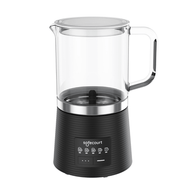
The good news: every conscious choice counts. You don’t have to do it all in one day. Replace your kitchen step by step, starting with the items that come into contact with hot food every day — your pan, your milk frother, your food storage. That’s where exposure is greatest.